
Meet Galaxy
Your Data Analysis Platform
Open source platform for accessible, reproducible, and transparent computational research. Used by researchers across the globe on free public infrastructure.

How Galaxy Works
From raw data to published results in three steps.
Bring Your Data
Upload from your computer, paste links, or pull from public archives.
Run Your Analysis
Launch curated workflows or build your own from 10,000+ tools — no programming required.
Share & Reproduce
Every step is tracked. Publish datasets, workflows, and complete analysis histories.
Galaxy in Action
Powering large-scale science and training worldwide.
Vertebrate Genomes Project
The Vertebrate Genomes Project uses Galaxy to produce high-quality reference genome assemblies, aiming to cover all 74,000+ vertebrate species. Assembly workflows are freely available on all three public servers.
Learn more →Galaxy Training Network
Free, peer-reviewed tutorials for researchers at every level. The 2025 Galaxy Training Academy brought together 3,500+ participants in the largest biological data analysis training event of its kind.
Explore training →Latest News
View all →miaDash: explore microbiome data interactively in Galaxy
The miaDash Shiny app from the Bioconductor microbiome team is now an interactive tool on usegalaxy.eu: import, analyse and visualise microbiome data without writing a line of code.
Galaxy (UFR) joins the EOSC-MESH Kickoff in Ghent, Belgium
EOSC-MESH kickoff meeting in Ghent: Galaxy helps extend the European Open Science Cloud!
One Day, Many Tool Updates: microGalaxy Hackathon Recap
Eight contributors, one day, and a pile of outdated metagenomics tools — here is what the October 14th microGalaxy hackathon achieved!
Cite Galaxy
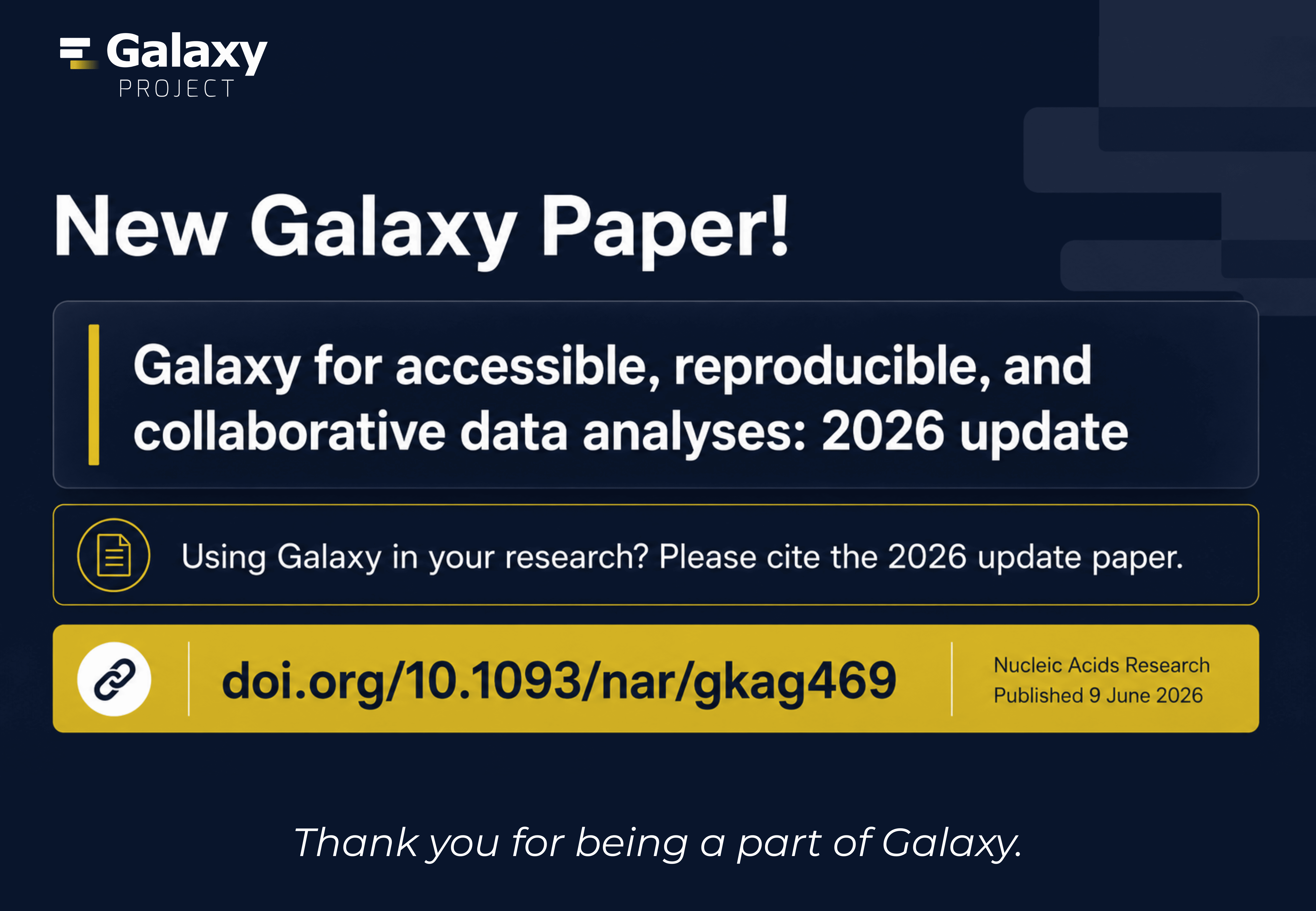
The Galaxy Community. Galaxy for accessible, reproducible, and collaborative data analyses: 2026 update. Nucleic Acids Research, 2026; gkag469, doi:10.1093/nar/gkag469
Full citation guide →