
IBSB 2026 – Bringing Galaxy Bioimage Analysis to Jena
Galaxy bioimage analysis at IBSB 2026 in Jena: a symposium talk, a hands-on workshop and new tool collaborations.
On this page
IBSB 2026 - Bringing Galaxy Bioimage Analysis to Jena
A warm welcome in the city of Carl Zeiss
Jena, the city where Carl Zeiss built his pioneering optics company, gave us a very warm welcome at IBSB 2026. It felt fitting to share Galaxy for bioimage analysis in a place with such a long history of making microscopy possible.
In mid-September 2026, the workshop (September 16–17) and the symposium (September 17–18) were hosted at Leibniz-HKI by the Applied Systems Biology research group, and the symposium opened with a welcome from Thilo Figge.
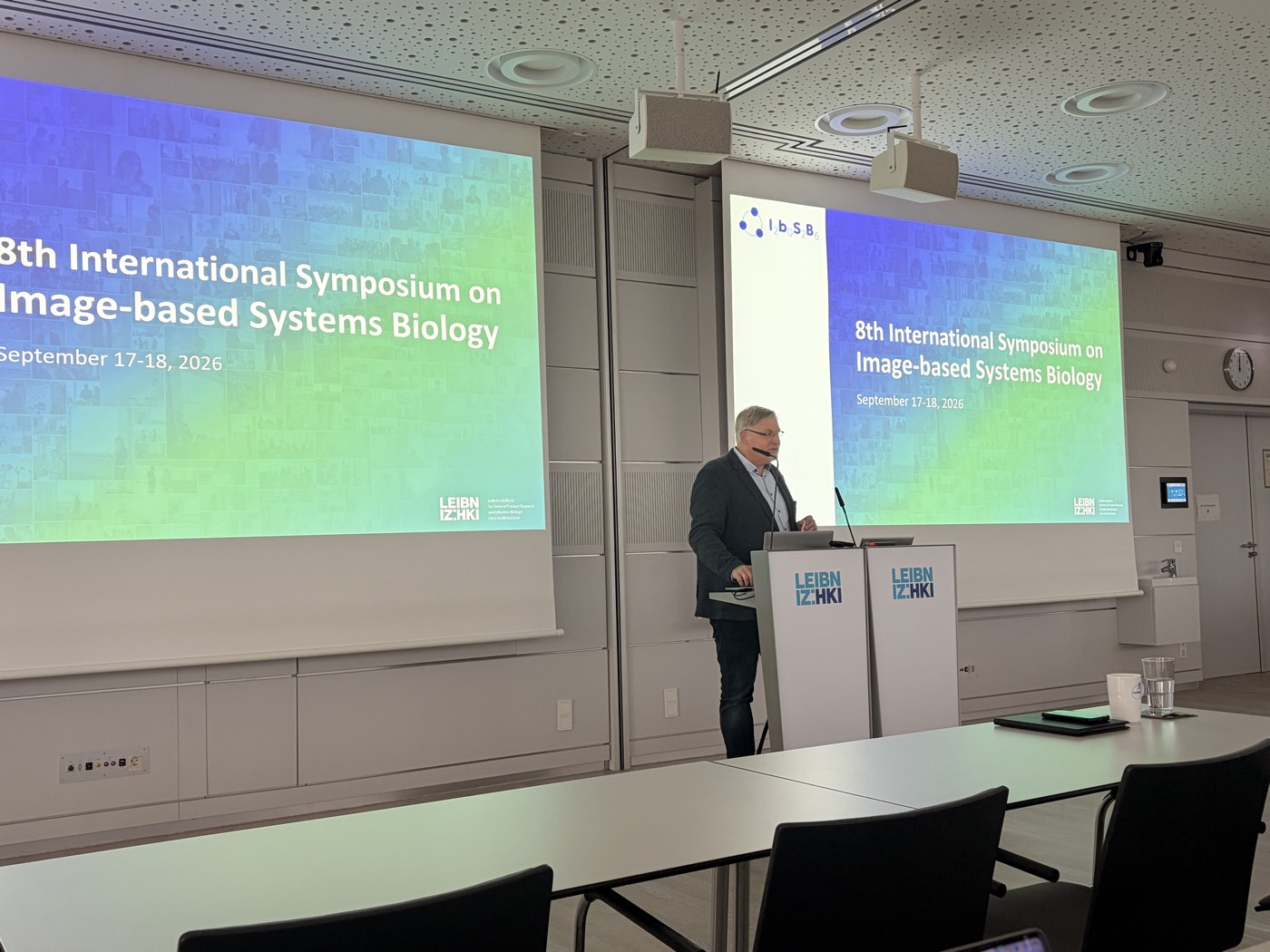
Thilo Figge opening the 8th International Symposium on Image-based Systems Biology (IBSB 2026). 📸 Joel Lüthi
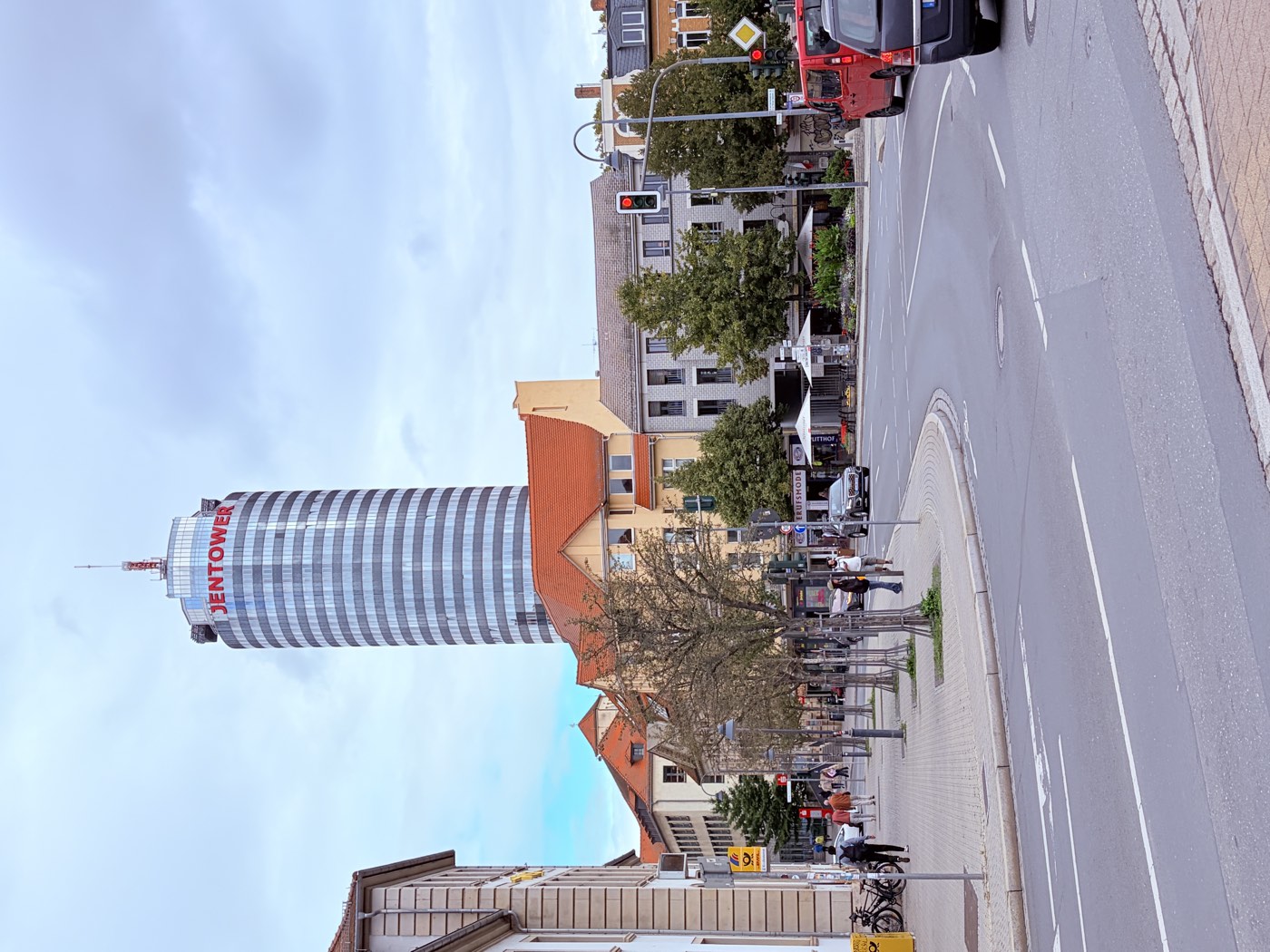
Jena and the JenTower. 📸 Diana Chiang Jurado
Symposium talk: FAIR Bioimage Analysis in Galaxy: From Data to Discovery
In the symposium I presented Galaxy as an open-source platform for FAIR bioimage analysis: its interface, the image analysis tools available, and the tutorials and training materials in the Galaxy Training Network.
The talk included two imaging use cases:
- Bringing use cases to Galaxy for FAIR: a histopathology imaging use case, taken directly from an experimental research lab into Galaxy.
- Extrapolating imaging workflows from one field to other fields: a Voronoi segmentation workflow that works for images from four Galaxy communities: astronomy, life science, earth and climate.
The audience was curious about two things: what Galaxy offers as a set of computational tools for imaging, and what sits behind it. We had great conversations about the infrastructure, where the computational resources come from, and how a large international community like Galaxy sustains its services.
Galaxy workshop: hands-on with imaging tutorials
On Thursday, September 17, eight participants joined the Galaxy session of the workshop “Image analysis with BAND, Nextflow and Galaxy”. Working directly in the browser on usegalaxy.eu, with no installation and no programming needed, we went through two Galaxy Training Network tutorials:
Learning about OME-Zarr
Beyond our own sessions, the talks by Joel Lüthi (University of Zurich) and Christian Tischer (EMBL) were a great opportunity to learn more about data formats such as OME-Zarr. Galaxy is working on adapting its imaging tools so that, in the future, they can support OME-Zarr data.
Connecting with tool developers
IBSB 2026 was also a good place to meet people who want to bring their tools to Galaxy.
- BaSiCPy: a Python implementation of BaSiC for illumination/shading correction in microscopy images, with automatic parameter tuning, foreground-aware correction, and support for large datasets and GPU processing. Its developers are interested in making it available in Galaxy, starting with two operations: estimating illumination profiles and applying previously estimated profiles. See the preprint, the code and the documentation.
- Cell Painting workflows: a collaborator is building an image analysis workflow in Galaxy for Cell Painting assays. Through this collaboration, the pycytominer tool suite was added to Galaxy, with Riccardo Massei assisting with the integration and then writing a tutorial to support users: Use Pycytominer in Galaxy for processing high dimensional image-based readouts.
A growing imaging community
The Galaxy imaging community keeps growing and developing to provide support and resources to the image analysis community, on an open-source, FAIR platform that aims to democratize image data analysis beyond the life sciences.
If you work with images, or have a tool, or workflow you would like to see in Galaxy, you are welcome to:
- Visit the Galaxy Image Analysis Community (SIG) page
- Join the Matrix channel for live discussions and updates
Many participants at the event suggested that the Galaxy imaging community should also join the Image.sc forum, and we are now discussing how to make that happen.
Thank you
Thank you to the organizers of IBSB 2026, and especially to Thilo Figge and Lisa Herbich, for the invitation, the hospitality and the organization. It was a pleasure to show Galaxy imaging to the bioimage analysis community in Germany.