
Genotyping Cyclospora: assessing current practices
The first post in a four-part BRC Analytics series on Cyclospora outbreak analysis: what public genomes, genotyping panels and sequencing data actually exist, and how an independent open implementation of the published eight-marker method is being built and validated in Galaxy.
On this page
Genotyping Cyclospora: assessing current practices
The 2026 cyclosporiasis season is the largest on record in the United States. CDC recorded 10,468 laboratory-confirmed domestically acquired cases between 1 May and 3 August 2026, with 517 hospitalisations, 2 deaths and 47 states reporting.
A new post on the BRC Analytics blog opens a series on the analysis of Cyclospora outbreaks. It is the first post in a four-post series; parts 2 to 4, covering the tooling and the Galaxy workflow, are still to come. Some highlights from the series:
C. cayetanensis assemblies are bad
Forty-nine C. cayetanensis assemblies are public. None is chromosome-level, two are annotated, and the median one is in 1,391 pieces.

This is why Cyclospora is typed from a small panel of amplicons rather than from genomes, and it is the starting point for the independent open implementation of the published eight-marker method that the series will build in Galaxy.
Current typing is done by ampliconic sequencing
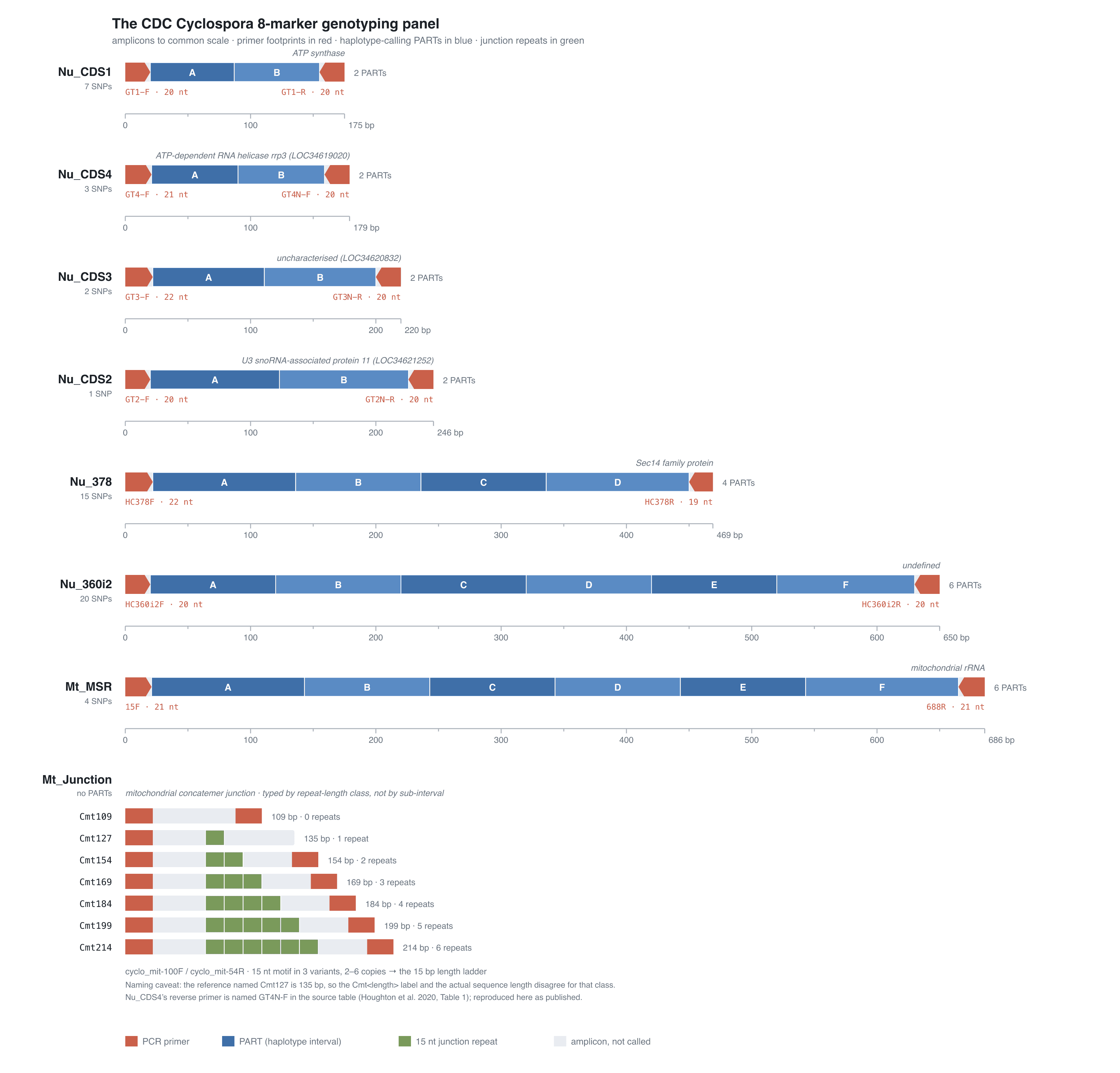
Cyclospora is typed from small panels of PCR amplicons. Four approaches appear in the public record: CDC’s eight-marker panel (six nuclear, two mitochondrial), an FDA 52-locus assay sensitive enough for food rather than stool alone, an expanded 63-marker scheme with no published marker list, and mitochondrion-only typing. The eight-marker panel dominates — 8,522 of the 9,016 public amplicon runs used it, against 494 across the other three — and it is the only one with a published set of outbreak cluster labels to score a pipeline against.
Current tooling is suboptimal
The method works; the code that implements it does not. CDC’s released R pipeline fails on three counts, all in the shipped source. It cannot run on any R ≥ 4.2, because as.vector() on a data frame changed behaviour at that release. import_data_V2.r stops with subscript out of bounds on CDC’s own 203-specimen 2018 reference population — its specimen-retention filter hardcodes four marker names, and the same file’s drop rule has just deleted one of them.

We have a new approach: PyEuk
PyEuk reimplements the distance and clustering steps in Python. It is Apache-2.0, installs with pip (and soon with BioConda), and depends only on NumPy, SciPy, pandas and scikit-learn. The path runs from multi-locus completeness filtering and binary encoding through population-genetics allele weighting, high-speed parallel KING-wIBS pairwise distance, a Euclidean metric repair, deterministic Ward linkage, and dynamic tree cutting. On the same 153-specimen sheet and the same host, the legacy heuristic under R 4.1.3 took 370, 507 and 655 seconds across three runs; PyEuk in a pinned container took 1.56, 1.56 and 1.73 — between 230× and 400× faster.

And it is coming to Galaxy
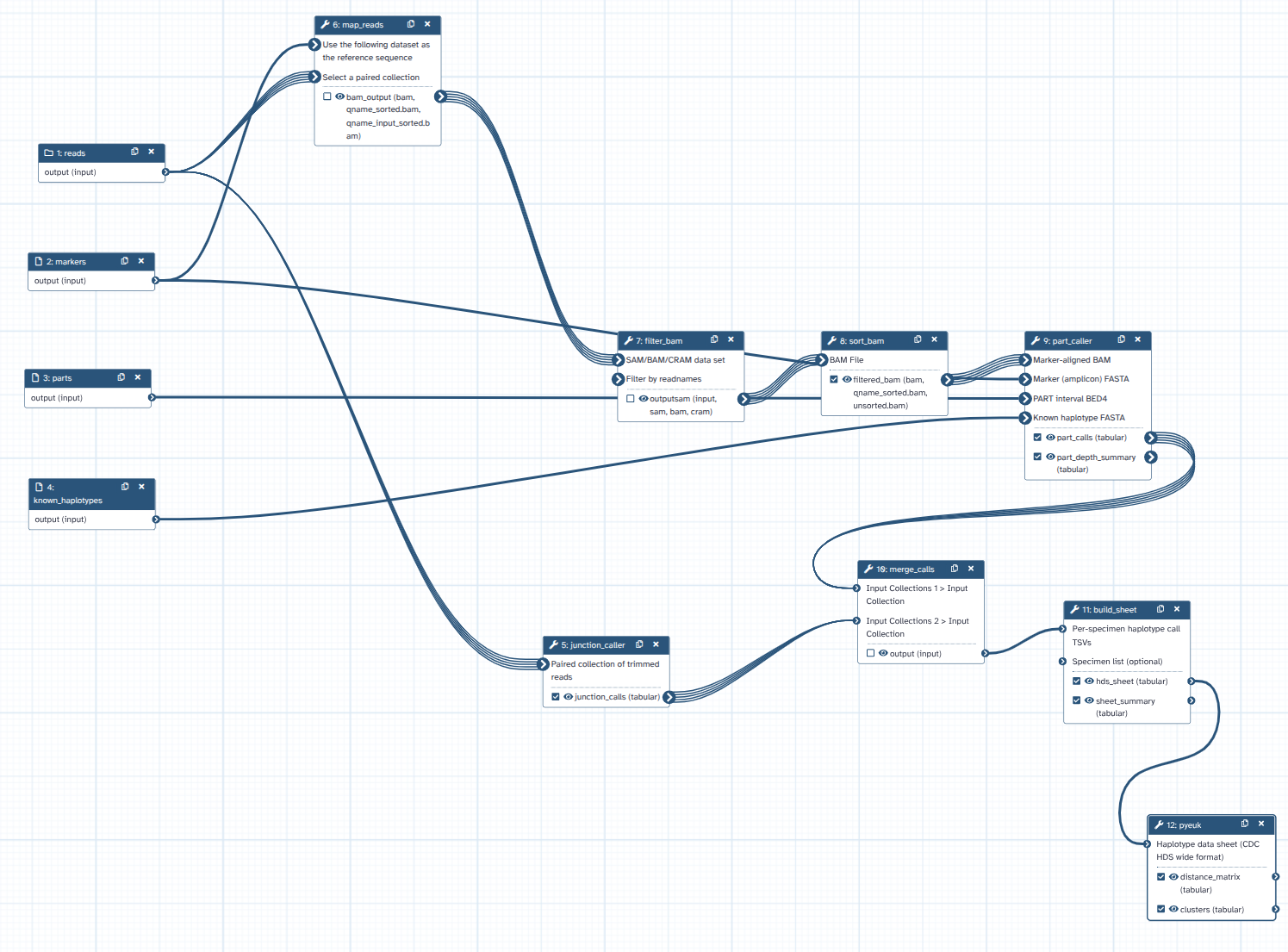
It is now a Galaxy workflow.
All of this is coming to BRC-analytics, IUC, IWC, and GTN.